.png&w=1920&q=75)

Softr for E-Commerce: Can You Really Sell Products?
The trap in this question is the word e-commerce, because it smuggles in a picture: carts, shipping rates, tax tables, a warehouse. If that picture is your business, the honest answer comes first: build on Shopify or its kin, that machinery is their whole life's work.
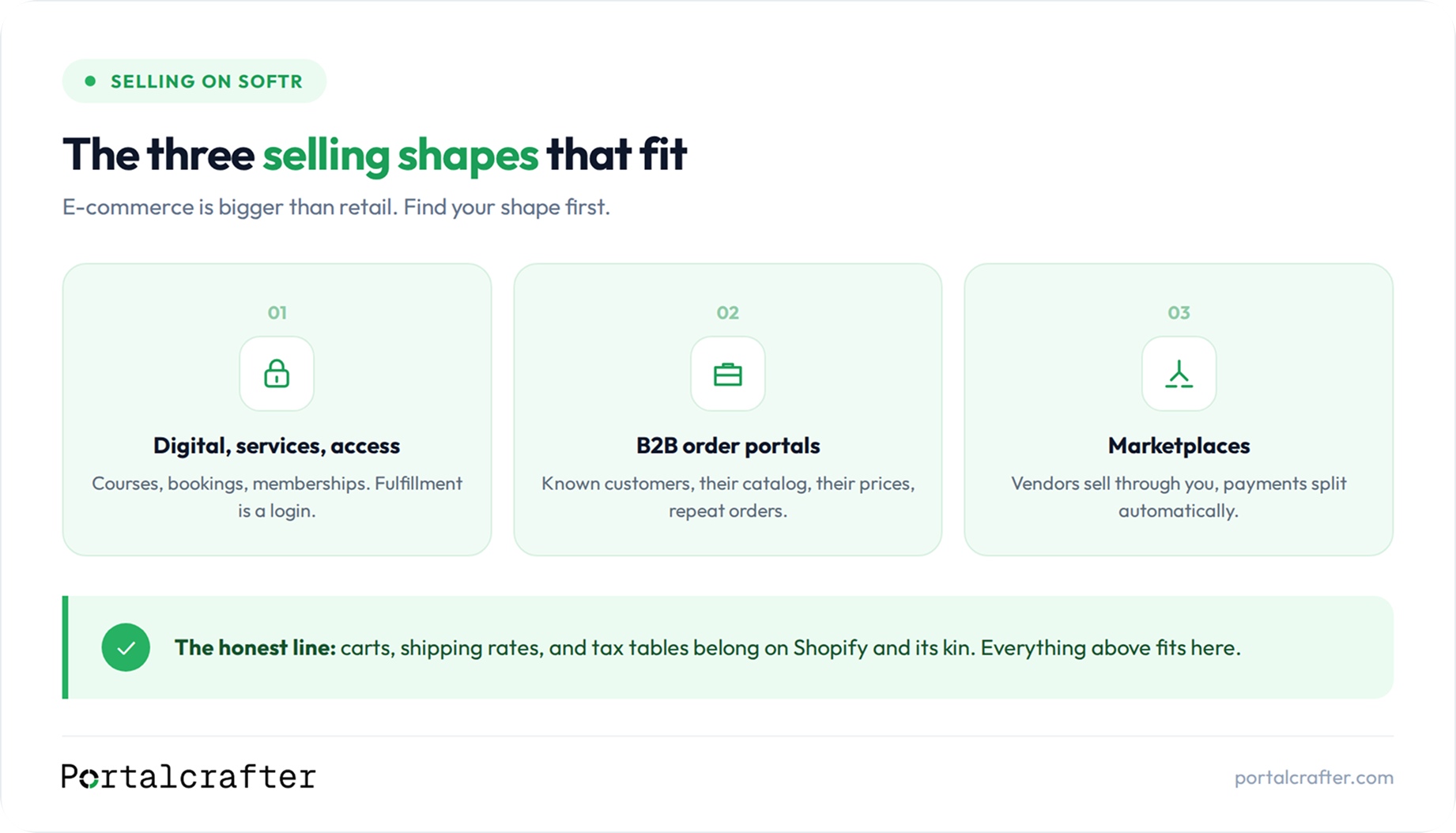
But e-commerce is bigger than retail, and three selling shapes that do not need a cart at all are exactly where Softr is strong. Most people asking this question turn out to be building one of the three.
Short answer: yes, for three shapes, and honestly no for full retail
Softr sells well when the thing sold is digital, a service, access, or when the buyer is a business ordering through a portal, or when you are the marketplace and others do the selling. It is the wrong tool for consumer retail with carts, shipping logistics, and tax complexity. Knowing which side you are on settles the question in a minute.
Shape one: digital products, services, and access
Selling without shelves: courses, templates, downloads, consultations, bookings, memberships. The buyer pays through Stripe checkout and receives the thing, a file, a booking, a login, a tier of access. No shipping, no cart mathematics, just payment and fulfillment.
This is a huge share of modern selling, and it is native Softr territory because the fulfillment is usually access, and access is what Softr's logins and permissions already do. A course platform, a paid community, a productized service with a book-and-pay page, all of it is this shape.
Shape two: the B2B order portal
Here is the quietly powerful one. Wholesale and B2B selling rarely looks like a public store; it looks like known customers ordering repeatedly at negotiated prices. That is not a cart problem, it is a portal problem: each business client logs in, sees their catalog and their pricing, places orders, and checks order history and invoices.
Softr fits this shape better than retail platforms do, because the hard part is per-client permissions and clean order records, not shipping calculators. If your selling sentence is "our trade customers email us orders," a B2B portal is the upgrade, and it is a build we ship regularly on the same pattern as every database-driven site: catalog as records, orders as records, portal as the window.
Shape three: the marketplace
When you are not the seller but the platform, vendors, instructors, or providers sell through you and you keep a commission, that is marketplace territory, and Softr with Stripe Connect handles the full machinery: vendor onboarding, automatic split payments, and vendor dashboards with earnings and payouts. We wrote the complete plain-language version in the vendor portal breakdown.
This shape scales past retail in one important way: your catalog grows because vendors grow it, not because you stock it.
Where Shopify and friends win, said plainly
Consumer retail with physical goods: carts holding many items, shipping rates by region, tax rules by jurisdiction, returns, discount engines, fulfillment integrations. Dedicated retail platforms have spent two decades on exactly that machinery, and rebuilding it in an app builder is the expensive route to a worse store, the same pretending-tools-are-each-other mistake we call out in every comparison we write. If retail is the business, use the retail platform, and note that the hybrid remains available: the store sells, while a Softr portal beside it handles the trade clients, the memberships, or the vendor program.
A worked example, one business, two tools
A specialty coffee roaster makes the split concrete. Their retail bags sell on Shopify, carts, shipping zones, holiday discount codes, exactly the machinery retail platforms exist for. Their wholesale side, forty cafes ordering weekly at negotiated prices, moved off email into a Softr B2B portal: each cafe logs in, sees its price list, places the standing order in two minutes, and checks invoices without calling anyone. Same company, two selling shapes, each on the tool built for it, and neither tool bent out of shape. That pairing, not a platform war, is what the answer usually looks like in practice.
Frequently asked questions
Can Softr handle a shopping cart? Single-item and simple purchases through Stripe, yes. Multi-item carts with shipping and tax logic, no, that is the retail-platform line, and it is the clean test for which tool your business needs.
Can I sell subscriptions and one-time products together? Yes, the four payment shapes mix in one app, each with its own product and its own unlock. A course platform selling workshops beside a membership is the everyday example.
What about digital delivery, how do buyers get the thing? Payment flips access: the buyer's account gains the tier, the download page, or the booking. Fulfillment is permissions, which is why this shape fits Softr so naturally.
Where does my product data live? The standing answer: Softr DB for a fresh start, Airtable if you already run there, or the system you have. For product-heavy businesses the catalog often lives in Airtable and feeds everything, which is exactly the next post in this pair.
The short version
You can really sell on Softr, in three shapes: digital products, services, and access, where fulfillment is a login; B2B order portals, where known customers order at their prices; and marketplaces, where vendors sell and payments split automatically. Full consumer retail with carts, shipping, and taxes belongs on Shopify and its kin, and the honest line between the two is the cart. Find your shape, and the tool question answers itself.
Selling sentence in hand, "we sell X to Y", book a free 30-minute call and we will tell you which shape it is and what it costs to build: https://calendly.com/vaibhavgarg0632/30min

 Softr
Softr