.png&w=1920&q=75)

What actually drives the price of hiring a Softr developer
There's no sticker price for a Softr build. Ask three developers and you'll get three different numbers, because the cost moves with a few things. Once you know what they are, you can read any quote and tell if it's fair.
How much your app has to do
This is the big one. A simple member directory is a small job. A client portal where people log in, see only their own records, pay through Stripe, and trigger automations behind the scenes is a much bigger one. Same tool, very different amount of work. When someone quotes you without asking what the app needs to do, that's a red flag.
Who you hire
A specialist who has shipped dozens of these charges more than someone doing their second project. Worth it, usually. The experienced person finishes faster and skips the mistakes that force a rebuild later, which often makes the higher rate the cheaper option in the end. Rates also swing hard by region, so a global freelancer and a local agency can quote wildly different numbers for the same work.
One build, or an ongoing hand
A one-time build is a one-time cost. If you also want someone on call for changes, fixes, and the inevitable 'can we add one more thing,' that's usually separate, either hourly or a small monthly retainer. Decide which you need before you ask for quotes, because it changes the total a lot.
What people actually pay
These are our published fixed prices, not estimates. They are fixed against a fixed timeline, and they do not move after we quote.
- A single-role client portal, directory, or one-purpose internal tool: $2,500, live in 10 days.
- Multi-role permissions, payments, and integrations like Stripe, Slack or Calendly: $6,500, live in 3 weeks.
- Marketplaces, two-sided payments, or unusual logic: $12,000–$18,000 over 4–8 weeks.
- Validating an idea before you commit: a demo-ready MVP for $4,500 in 14 days.
- Ongoing work after launch: optional retainers from $500/month. One-off tweaks are billed hourly.
Every build includes two rounds of revisions per phase and 14 days of free post-launch bug fixes, and you own the Airtable base and everything else we build. If we miss the agreed timeline by more than five working days, you get 20% back.
If you want one of these turned into a real number for your build, that is a scoping call, not a guessing game — you get a written fixed quote within 24 hours.
| Package | Fixed price | Live in | Best for |
|---|---|---|---|
| Portal Starter | $2,500 | 10-day delivery | Solo founders and small teams |
| MVP Sprint | $4,500 | 14-day delivery | Founders validating an idea |
| Portal Pro | $6,500 | 3-week delivery | Growing teams and agencies |
| Custom Build | $12,000 – $18,000 | 4–8 week delivery | Marketplaces and complex logic |
What you won't find below $2,500
You can find someone to build a Softr app for $500. We have rebuilt enough of those to know what the number buys, and it is worth being specific rather than sniffy about it.
- A template with your logo on it. Fast, cheap, and fine — until the first workflow that the template does not do, at which point there is nowhere to put it.
- One role. Multi-role permissions are where most portals actually get hard. If your clients, your team, and your admins all need different views of the same records, that is the work.
- A data model built to demo. The Airtable base under a cheap build is usually shaped to make the screens look right, not to survive the second year of records.
- No fixed date. A low quote and an open timeline is the same deal as an hourly one, with the uncertainty moved onto you.
- Nobody on the hook afterwards. When the automation breaks in month three, a $500 build usually has no one attached to it.
None of that makes a cheap build the wrong call. If you need a single-role directory to prove an idea this month, buy the cheap one — genuinely. It becomes the wrong call when the thing you are building is going to run your operations, because then the rebuild costs more than the original quote saved.
What the rest of the market charges
Rates in the Softr and Airtable ecosystem cluster into three bands. Bands rather than named competitors, because published rates move and a stale number about someone else helps nobody.
| Who you hire | Typical fixed price | What moves with it |
|---|---|---|
| Marketplace freelancer | $500–$2,000 | One role, template-led, timeline usually open |
| Specialist no-code studio | $2,000–$18,000 | Fixed scope and date, multi-role, integrations, support window |
| Custom development shop | $40,000+ | Bespoke code, 4–6 months, ongoing engineering cost |
We sit in the middle band, at $2,500 to $18,000. The honest summary of the top band is that it is not overpriced — bespoke code costs what it costs. It is simply the wrong tool for a client portal, which is a solved shape that does not need to be invented again.
The question worth asking any of the three is not the price. It is what happens if the date slips, and who owns the database when you leave.
The part where 'free' isn't free
Building it yourself costs money too. It just doesn't show up on an invoice. It shows up in three places.
Your time. Softr is friendlier than real code, but a proper app still eats hours. Planning it, building it, testing it, fixing the parts that break. Those are hours you're not spending on the thing you're actually good at, which is running your business. Put a real number on your hourly worth and the free build gets expensive fast.
The learning curve. If you've never touched Softr and Airtable, your first project is half building and half learning. You'll set things up one way, then rip them out and redo them once you understand how the tools actually work. That's a great investment if you plan to build a lot. It's a lousy one for a single project you just need live.
The redo. First builds usually get rebuilt. A data structure that looked fine in week one starts causing problems once real users and real records pile in, and untangling it later takes longer than doing it right the first time. Meanwhile every week the app isn't live is a week it isn't earning its keep.
A shop owner comes to us wanting a simple order portal for wholesale customers. On their own it's a month of evenings, a lot of Googling, and a structure they'd probably redo once. Built by someone who's done it before, it's live in a few days and it holds up when orders grow. Same app. Very different real cost.
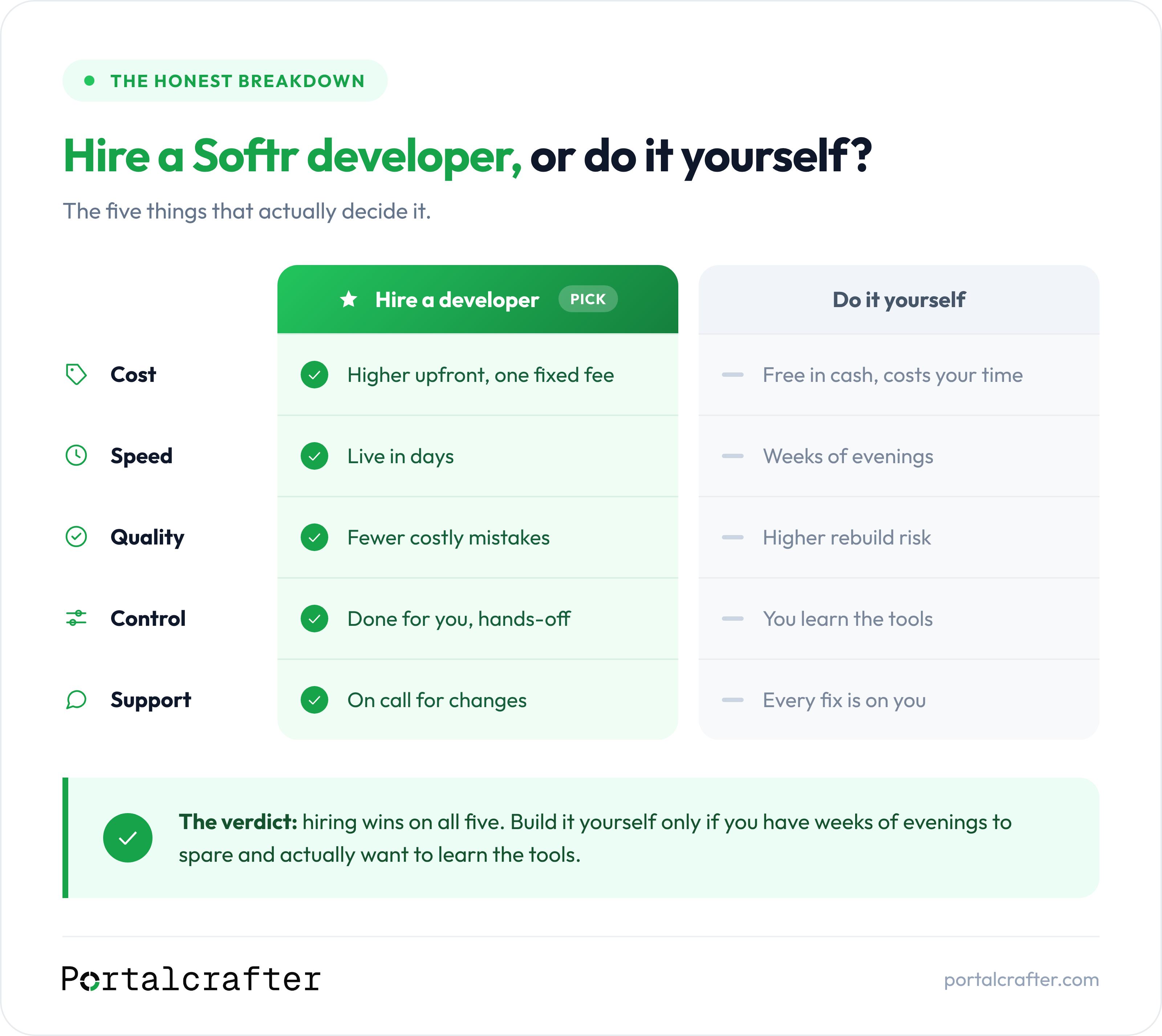
Hire or DIY, side by side
- Cost: hiring costs cash now. DIY costs your time and whatever that time could have earned you elsewhere.
- Speed: someone who's built these before ships in days. A first-timer takes weeks.
- Quality: an experienced builder dodges the structural mistakes that bite later. On your own, the risk of a rebuild is real.
- Control: building it yourself teaches you the tools and keeps everything in house, which genuinely pays off if you'll keep building.
- Support: a developer can stay on for changes. Solo, every future fix lands on you.
So which one is right for you
Build it yourself if the app is simple, you actually enjoy learning tools like this, you're not racing a deadline, and you expect to build more than one thing. The learning pays back across every project after this one.
Hire someone if the app matters to the business, you need it live soon, it has real moving parts like payments or multiple user types, or your hours are just worth more somewhere else. For most businesses where the app is not a hobby, hiring pays for itself in speed and in the rebuilds you never have to do. Here is what hiring a Softr developer actually involves, start to finish.
Honestly, the smartest move we see is a hybrid: hire for the first build so the foundation is right, then learn to handle the small changes yourself. Best of both.
Frequently asked questions
Is Softr cheaper than hiring a traditional developer?
Yes, and it's not close. A Softr build on Airtable costs a fraction of custom software, whether you do it yourself or hire a Softr specialist.
Can I build a Softr app with zero coding experience?
Yes. It's a no-code tool, so no code required. You'll still spend time learning it and thinking through how to structure the app.
How long does a Softr app take to build?
A simple one can be days. Add roles, payments, and integrations and it stretches out. An experienced builder is almost always faster than a first attempt.
What ongoing costs should I plan for?
Your Softr plan and your Airtable plan, since those host the app and its data, plus any hourly or retainer cost if you want someone available for changes.
The short version
What it costs to hire a Softr developer comes down to how complex your app is, who you hire, and whether you want ongoing support. Real projects land between $2,500 for a single-role portal and $18,000 for a marketplace with two-sided payments, with most multi-role builds at $6,500. Building it yourself isn't free either, it just bills you in time, a learning curve, and the odds of a redo. Simple app and time to learn? DIY can absolutely work. App that matters and needs to ship? Hiring is usually the better deal. Want a real number for yours instead of a range? Grab a free scoping call and we'll tell you straight.

 Softr
Softr